A Universe of QuestionsLEV NEYMOTIN · ESSAY & PODCAST LIBRARY
Browse categories & essays

EXPLORE A SUBJECT

Science & Technology

From fundamental ideas to artificial intelligence, engineering, and research proposals.

41essays in this subject

Enter a number (123 or #123), a topic, or “quotes” for a phrase. Numbers identify essays; use the year filter for dates.

Topics & reading length

Essays in this subject

41 of 41 essays · 1–12 shown

By Date uses the original PDF’s last-modified date. Publication dates are listed separately.

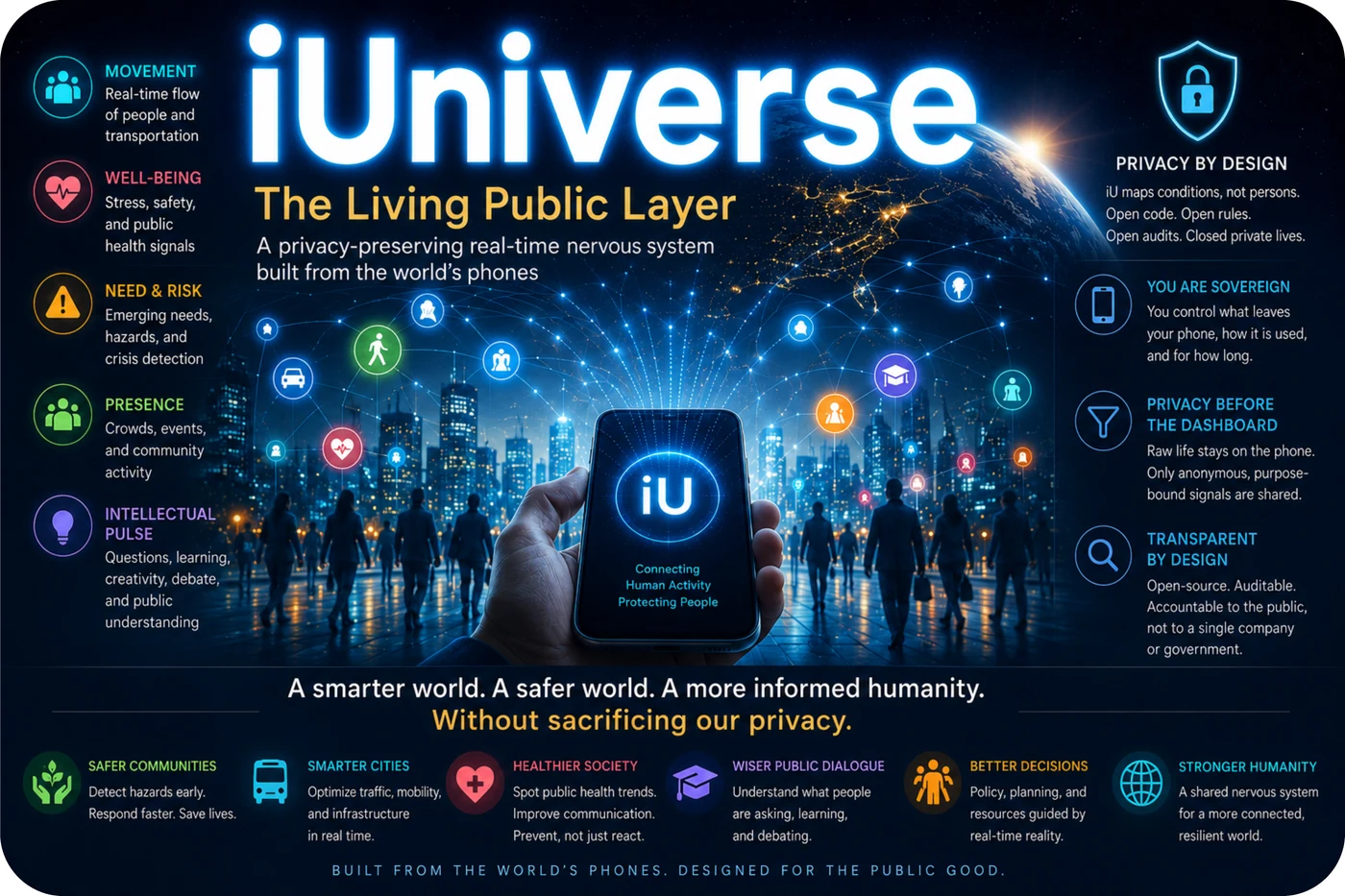
A Privacy-Preserving Real-Time Nervous System Built from the World’s Phones

The world already carries the sensors. The phones are already in our hands. The question is whether we can create public intelligence from private devices without turning private life into public property. That is the promise, and the danger, of iUniverse. It asks whether we can map conditions rather than persons, public patterns rather than private lives, and real-time needs rather than individual identities. iU should begin not as a universal system, but as a disciplined pilot. The first version should be small, voluntary, open-source, privacy-audited, and visibly useful. Open system, closed raw life.

Essay details
Merging Computational Neuroscience and Psychology for Adaptive Brain Simulation

This research initiative aims to bridge the gap between biophysical brain modeling and cognitive psychology by developing multiscale neural simulations that incorporate constructs such as intelligence, behavioral strategy, and adaptive learning. Building on my previously published thalamocortical auditory circuit models, which reproduce in vivo dynamics using NEURON and NetPyNE platforms, this work proposes to embed psychologically-informed modules into existing biophysical frameworks. The goal is to explore how cognitive factors–ranging from attention and motivation to cross-species intelligence differences–can influence neural plasticity, oscillatory dynamics, and learning trajectories.

Essay details

Why “Artificial Intelligence” Is a Misnomer – and Why Human-Sum Intelligence Is a More Honest Name

For decades we have used the term Artificial Intelligence to describe systems capable of producing language, solving problems, creating images, analyzing patterns, and accelerating discovery. Yet the more powerful these systems become, the clearer one truth becomes: there is nothing “artificial” about them. What we call AI is not a synthetic mind, not an alien intelligence, and not an independently created cognitive agent. It is, instead, a concentrated, accelerated reflection of us. Every model is built from human experience, human language, human creativity, human mistakes, human logic, and human values.

Essay details

A White Paper on Future-Resilient Jobs, Apps, and Services

Across sectors—from banking and healthcare to manufacturing and pharmaceuticals—organizations are rebuilding their “nervous systems” around AI while shedding human layers once considered indispensable. We face a choice: either let the new selection environment shape us blindly, or consciously design roles, tools, and institutions that preserve human agency, dignity, and responsibility. The job archetypes, apps, and services described here are not predictions in the narrow sense. They are proposals. The core question is not “Will AI destroy jobs?” It is: What kinds of humans do we choose to become when intelligence is cheap, but responsibility is not?

Essay details

Preliminary Plan

To develop an AI-based avatar capable of engaging in realistic, human-like conversations by extrapolating personality traits, knowledge, and behavior patterns from multimedia sources (writings, pictures, stories, voice recordings, etc.). The avatar will feature an audio-based human-avatar interface for seamless interaction.

Essay details

The Mystery That Bothered Me

I was always mystified: why does Earth have gold here, iron there, copper in another place — and diamonds, which aren’t even elements, in yet another? How do tiny atoms of gold find other gold atoms? How do iron atoms find iron? Geology textbooks answer with seven theories: magmatic differentiation, hydrothermal fluids, supergene enrichment, metamorphism, sedimentation, volcanogenic processes, and early crustal differentiation. If you need seven separate explanations for one phenomenon, maybe you don’t yet have the unifying story. The Trigger: Meteorites My suspicion deepened when I looked at meteorites. Some are made of almost pure iron–nickel alloy.

Essay details

A seemingly straightforward question—“Does the weight of a propeller affect the power required to spin it in a vacuum?”—opens a surprisingly deep path into physics. What begins as a problem in classical mechanics, involving rotational inertia and the motion of blades, soon extends into Newtonian gravity, Einstein’s relativity, and the modern understanding of gravitational radiation. In practice, the effect of a laboratory propeller is negligible for engineering. Yet conceptually it is profound, for it connects the mechanics of ordinary rotating systems to the grand phenomena observed by detectors like LIGO.

Essay details

Patent Prior-Art Analysis Summary

A method for manufacturing ice cream in which the gaseous phase (air or inert gas) is infused with food-safe volatile aromatic compounds, forming frozen microbubbles during aeration. Upon consumption and melting, these bubbles release aroma compounds into the retronasal pathway, enhancing the olfactory experience in synchrony with taste.

Essay details

1. INTRODUCTION

Exercise plays a critical role—alongside medical treatment—in managing and improving outcomes for people with diabetes. Numerous exercise regimens exist, tailored to patients of different ages and health conditions. The driving force behind the development of IsoTone is the need for a portable, easy-to-use device that supports exercise anywhere, at any intensity level, and for individuals in any physical condition. The goal is to make IsoTone a constant companion—always accessible, enjoyable, and effective in delivering a full-body workout. This presentation highlights IsoTone’s key features and provides an in-depth overview of diabetes as a medical condition.

Essay details

About the Author

Going back to my recent podcast related to Ray Bradbury’s Martian Chronicles (watch here: ), I was struck again by the idea of “electric bees” from one of the stories. In it, the guns of an automated house fired mechanical bees—tiny electric creatures launched like bullets. I couldn’t help but extrapolate Bradbury’s electric bullets to electric artillery shells and, ultimately, to E-Bombs. A regretfully unavoidable—and deeply alarming—extrapolation. I believe that modern science and technology have barely scratched the surface when it comes to utilizing the immense energy stored in the form of electricity—electricity tightly packed and locked within every atom.

Essay details

Pegasus Case

Pegasus, developed by NSO Group, is a highly advanced zero-click spyware—and yes, even an RSA-secured system can be compromised not by breaking RSA, but by bypassing its protections entirely. Pegasus does not break RSA math. It operates by infecting the device itself, reading decrypted messages and keys from memory, and intercepting user activity at the app level. So the encryption can be perfect—but it’s irrelevant if the attacker has access to the decrypted output and keys.

Essay details

Part I: A Problem as Old as the Kippah Itself

Enter Rabbi Sholom Ber Schapiro, a Brooklyn-based Hasidic scholar with a sharp mind and a keen eye for practical problems. One day, while teaching Chassidic philosophy, he noticed a student sitting bareheaded. When questioned, the young man simply replied that he had lost the bobby pin that held his kippah in place. Concerned that such a minor inconvenience might lead someone to forgo wearing a yarmulke altogether, Rabbi Schapiro decided to act.

Essay details
About this collection & how to use it

This collection contains 352 selected essays, research papers, proposals, and supporting documents—with or without podcasts. Introductions draw closely from the PDFs’ preambles, executive summaries, openings, and conclusions. Passages may be shortened and joined; they are close adaptations, not necessarily continuous quotations. They express the source authors’ positions, not independent verification of every claim. Contributed material is attributed separately where identifiable.

Search words in titles, summaries, topics, authors, and podcast titles. Turn on Search inside PDFs to include extractable document text. All search words must appear somewhere in a record or its PDF; use quotation marks for a phrase. A PDF result shows the first relevant file page. Text embedded in images or affected by extraction defects may not be searchable.

Dates are separate: “By Date” sorts by the original PDF file’s last modification, latest first—not its upload or copy date. “By Name” sorts A–Z. “Essay” is a document date where reliably identifiable; “Podcast” is the YouTube publication date. Missing dates are marked “Not stated” and never inferred from the recording. Year-only or month-only dates retain that precision. Newest sorts place undated items last.

304 entries have matched podcasts, representing 280 distinct recordings. A recording may discuss more than one source. 46 entries are essay-only; 2 more remain available with uncertain primary podcast links withheld. Linked podcasts stay on YouTube. PDFs here are unchanged copies, not live links to Dropbox. Retained companion papers and alternate editions remain separate.

Research concepts and proposed medical or financial methods are presented for reading and discussion, not as established treatments or individualized professional advice. A proposal’s presence here does not imply clinical validation, regulatory approval, or an investment recommendation.

Readers can browse freely. Only the signed-in author can exclude or restore essays, assign them to one or more categories, or add categories. Category counts may overlap; the overall total counts each essay once. Confirmed changes are saved in the site database; the original source inventory and PDFs remain unchanged. The PDF reader’s return bar restores your previous view. Search filters remain in the address bar. Copyright and authorship remain with the respective rights holders.

Visit statistics: This Catalog counts page views, PDF reader opens, download clicks, and YouTube link clicks for the author. It uses a temporary, random browser-tab token, not tracking cookies, and stores no names, email addresses, IP addresses, search terms, or individual browsing histories. Duplicate-prevention tokens expire after 48 hours and are removed as new events arrive. Daily totals are retained. Do Not Track and Global Privacy Control signals are respected. YouTube has its own privacy practices.

Privacy & visit counting · Download catalog (CSV) · Download catalog (JSON)

Back